
 Factal
Week of July 17-24
A Look Ahead
Welcome to Factal Forecast, a look at the week’s biggest stories from the editors at Factal.
We publish our forward-looking note each Thursday to help you get a jump-start on the week ahead.
July 16 | Trump speech
U.S. President Donald Trump announced that he will address the nation at 9 p.m. ET on Thursday, without specifying the topic of his remarks.
What’s happened so far
Trump’s speech comes amid renewed fighting in Iran that could threaten Middle East regional and international stability. U.S. airstrikes this week targeted “Iran’s ability to attack commercial shipping” and sparked retaliatory Iranian strikes on U.S. assets in the Middle East including Bahrain and the United Arab Emirates. Preparations for midterm elections in the United States are also underway.
The impact
On Monday, Trump said the United States would reimpose a naval blockade on Iranian ships in the Strait of Hormuz and act as “the Guardian of the Hormuz Strait.” The president has yet to give a precise reason for the speech. An anonymous U.S. official told Reuters that Trump would discuss new information regarding investigations into elections, potentially linked to the 2020 election in which he accused former President Joe Biden of electoral fraud. Others expect the president to focus on recent developments regarding Iran in the Middle East and the future outlook for operations.
July 19 | São Tomé and Príncipe presidential election
The small African island of São Tomé and Príncipe will elect its new president on Sunday, just two months before it also picks a new government.
What’s happened so far
Five candidates are officially in the race, including incumbent President Carlos Manuel Vila Nova, university professor Eugénio Tiny, MP Nito d’Abreu and lawyer Miques João. The fifth candidate, Jorge Bom Jesus, dropped out after the deadline.
The impact
These elections come just two months before the scheduled legislative vote that will elect a new government. Last year, an internal crisis inside the ruling party broke out when Vila Nova dismissed the government of Patrice Trovoada and picked Américo Ramos as the new prime minister against the party’s wishes. The campaign has been mainly marked by a focus on institutional stability and ways to address economic problems, with all candidates calling for a peaceful electoral process.
July 20 | Colombian congress sworn in
Colombia’s newly elected congress will be sworn in Monday, setting up a governing test for President-elect Abelardo De la Espriella, who won the presidency without a legislative majority to back his agenda.
What’s happened so far
The March 8 legislative elections produced a divided congress in which no party secured a majority, and traditional and centrist parties have been left with significant influence over any future governing coalition. The new congress will take office only weeks before right-wing De la Espriella, who narrowly defeated leftist Iván Cepeda in the June presidential runoff, is due to be sworn in on Aug. 7. He campaigned on ending peace negotiations with armed groups, expanding oil and gas production, lowering taxes and reducing the size of the state, while Cepeda pledged to preserve much of former President Gustavo Petro’s progressive agenda.
The impact
As De la Espriella enters office without a congressional majority to advance his security, economic and energy agenda, he will need support from liberals, conservatives and other smaller parties. This potentially forces him to moderate proposals such as shrinking the size of the state by up to 40 percent, reversing restrictions on new oil development and abandoning negotiations with armed groups. The incoming congress may also face an immediate decision over De la Espriella’s request to take the presidential oath at a military installation outside Bogotá, which would require lawmakers to authorize temporarily relocating Congress.
July 22 | Venezuela’s Nicolas Maduro appears in U.S. court
Former Venezuelan President Nicolas Maduro is scheduled to appear in a U.S. court on narcoterrorism and drug trafficking charges Wednesday.
What’s happened so far
In January 2026, U.S. forces raided Caracas and arrested Maduro and his wife, Cilia Flores, taking both of them back to American soil. Maduro appeared in Manhattan’s U.S. Southern District court in March as prosecutors alleged he ran a corrupt government that used “government power to protect and promote illegal activity.” The court hearing for Maduro and Flores, originally scheduled for June 30, was postponed until July 22.
The impact
A U.S. judge refused to dismiss drug trafficking charges, and both Maduro and Flores have remained in custody since January. Former Panamanian leader Manuel Noriega, who was captured by U.S. forces in 1989, was sentenced to 40 years in prison for drug-related charges. While critics have said Maduro and Flores’ capture contravened international law, this case may test U.S. jurisdiction over former heads of state. Protests are expected, as demonstrators gathered outside the New York City court in March to support Maduro.
July 22 | Protests planned against Keiko Fujimori in Cusco, Peru
Lawmakers in Cusco, one of Peru’s largest cities, are calling for people to take to the streets on Wednesday following what they say was a “systematically rigged” presidential election.
What’s happened so far
Peru has gone through multiple political crises in recent years, notably when President Pedro Castillo attempted a “self-coup” in Dec. 2022 by trying to dissolve congress and impose a curfew. It led to Dina Boluarte being sworn in as president, and she became one of the worst polling world leaders in history. She was removed from office last October unanimously, which led to the general election between Fujimori, a far-right candidate whose father was convicted of war crimes for massacres that happened during his time as president, and left-wing Congressman Roberto Sánchez. Just days before the runoff, Peru’s electoral authorities raised eyebrows by declaring votes from abroad must be sent physically instead of a ballot scanning system. The Organization of American States questioned it but later said no irregularities were found. Election officials declared Fujimori the official winner by less than 50,000 votes after weeks of counting.
The impact
The results of the election perfectly illustrate how split the population of Peru is on a political level. Sánchez also is calling for widespread protests on July 28, the same day as Fujimori’s swearing-in, after calling for overseas votes to be annulled. He has also threatened to not recognize Fujimori as president. She will come into office and try to lead a fractured country that has rarely seen stability in its politics.
July 23 | Commonwealth Games begin
The Commonwealth Games, an 11-day multi-sport celebration, will be held in Glasgow, Scotland, starting Thursday.
What’s happened so far
Following the withdrawal of Australian state of Victoria as host over cost concerns, the Scottish city of Glasgow stepped in and confirmed that it will host a stripped-back edition of the event this year. The games will feature 10 sports across four venues, including athletics, swimming, artistic gymnastics, track cycling, netball, weightlifting, boxing, judo, bowls and 3×3 basketball.
The impact
Questions about the future of the Commonwealth Games have been swirling again after Victoria pulled out. The South Africa city of Durban also dropped out as host of the 2022 game due to financial constraints. While fewer countries are interested in hosting the celebration due to the sheer cost of it, some are positive that the scaled-down model by Glasgow this year could be a blueprint for future games. Scottish police said they will be working closely with organizers to ensure safe delivery of the events, with security heightened around the venues and arrangements to prevent cyber attacks.
July 24 | Rescheduled White House Correspondents’ Dinner
The rescheduled annual White House Correspondents’ Dinner will be held Friday in Washington, D.C.
What’s happened so far
The event, an annual dinner attended by the president of the United States as well as other cabinet members, congressional lawmakers and journalists, was originally scheduled in April and underway when an armed suspect attempted to storm through security at the venue. Prosecutors allege the suspect, who was armed with a shotgun and a handgun, was attempting to assassinate President Donald Trump before being taken into custody following an exchange of gunfire with a U.S. Secret Service agent.
The impact
Next week’s gathering will be held with heightened security measures following April’s attack and Trump has confirmed he will attend the dinner and speak. Trump, meanwhile, seized upon the foiled attack to continue to make the case for his planned White House ballroom, which he claims is a more secure venue as legal challenges against the ballroom renovations mount.
What Else Matters
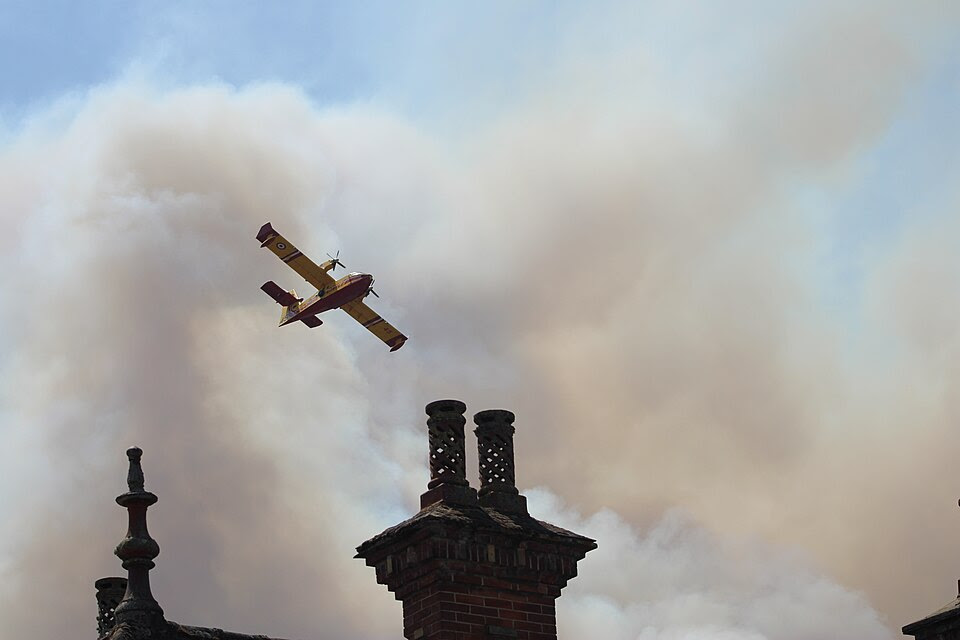
(Baidax / Wikimedia Commons / CC BY-SA 4.0)
Wildfire near Paris
Emergency services battled with an “exceptional in scale” fire that erupted in the Fontainebleau forest to the southeast of Paris on Sunday afternoon. The blaze spread swiftly, covering over 3,000 acres of land, prompting the evacuation of at least 900 people from nearby villages and disrupting high-speed rail links. French authorities indicated Monday the fire may have been set deliberately and two suspects were subsequently arrested in connection with the blaze.
Watch for: The fire erupted as France faces its third major heat wave since May, creating ideal conditions for wildfires in the country. The French interior minister said the Fontainebleau fire is just the latest in what will likely be a record year for fires in the European country, with almost 80,000 acres already burned this year. EU data shows the total area affected by fires in the European Union this year has reached 384,419 acres, which remains below 2025, the worst year on record, but is still above the average for the last 20 years. The European Center for Medium-Range Weather Forecasts said record-breaking temperatures in Europe in June underscored how profoundly the climate is changing, adding the result is “increasingly intense heatwaves, a persistently warm ocean, and growing risks for people, ecosystems and infrastructure across Europe and beyond.”
U.S.-Iran war resumes, expands
The United States and Iran have all but destroyed the Pakistani-mediated ceasefire they signed a month ago, now regularly engaging in exchanges of attacks on each other and escalating to widen the conflict further to Arab Gulf countries. The warring parties have so far avoided striking high-profile targets such as capital cities or energy and transportation infrastructure. Israel, which helped the United States start the war by attacking Iran in February, has also remained inactive during the latest phase of escalation.
Watch for: Iran is reporting dozens of people killed in the latest round of U.S. airstrikes, which has been limited to its southern coastline along the Persian Gulf and Strait of Hormuz. Despite attacks on ships and drones launched at some Gulf countries, it has yet to retaliate with strikes comparable to those it employed during the most intense phase of the war. Meanwhile, U.S.-ally Saudi Arabia and Iran’s Houthi militant group in Yemen may be on the verge of expanding the conflict after exchanging missile attacks, one of which hit Sanaa airport, representing the most significant escalation since the start of Yemen’s own four-year-old ceasefire deal. With oil prices back on the rise and the end of the first phase of the supposed U.S.-Iran ceasefire agreement looming in less than a month, the prospect of a permanent end to the war and reopening of the Strait of Hormuz for unrestricted maritime travel in the near term is eroded.
Factal Forecast Podcast
Editors Jimmy Lovaas and Ahmed Namatalla discuss the renewed U.S. blockade and attacks on Iran as well as new escalations in Yemen, plus more on Colombia’s new congress getting started, former Venezuelan President Nicolas Maduro appearing in a U.S. court, protests in Peru, and the White House Correspondents’ Dinner.
Subscribe to the show: Apple Podcasts, Spotify, and many more.
This episode includes work from Factal editors Ahmed Namatalla, Clara Ip Wai Nam, Michael Archer, Jeff Landset, and Alex Moore. Produced and edited by Jimmy Lovaas. Music courtesy of Andrew Gospe.
Extended Outlook
What’s on our radar in the coming weeks…
July 17-24
July 17
- Tomorrowland begins in Boom, Belgium
- California State Fair begins
July 18
- Nelson Mandela Day
July 19
- Sao Tome and Principe presidential election
- FIFA World Cup final
July 20
- Inauguration of Colombia’s new Congress
- Outgoing Colombian president calls for marches against incoming president
July 21
- 19th Australian Space Forum in Adelaide
- Belgium National Day
- The Hundred cricket tournament
July 22
- European Central Bank Monetary Policy Meeting
- Venezuela’s Nicolas Maduro appears in U.S. court
- Protests planned against Keiko Fujimori in Cusco, Peru
July 23
- Commonwealth Games begin
- Belgian Grand Prix
- Delaware State Fair begins
July 24
- Rescheduled White House Correspondents’ Dinner
- Montana State Fair begins
July 25-31
July 25
- 2026 WNBA All-Star Game
- Women’s Africa Cup of Nations football
July 27
- Pakistan-administered Jammu and Kashmir general elections
July 28
- U.S. Federal Reserve Meeting
- Peru’s Keiko Fujimori expected to be inaugurated as president
July 29
- Ohio State Fair begins
July 30
- Bank of Japan Monetary Policy Meeting
- Women’s British Open
- Lollapalooza begins in Chicago
- Bangor State Fair begins in Maine
July 31
- New Jersey State Fair begins
Aug. 1-7
Aug. 1
- State elections for Negeri Sembilan, Malaysia
- Primaries in Guam and U.S. Virgin Islands
- UK opens first ‘super-university’ as Kent and Greenwich merge
Aug. 3
- Maryland state lawmakers will hold a special session on redistricting
Aug. 4
- Primaries in Missouri, Michigan and Virginia
Aug. 6
- State Fair of West Virginia begins
- Wisconsin State Fair begins
- Primaries in Tennessee
Aug. 7
- Inauguration of 43rd president of Colombia
- Outside Lands begins in San Francisco
- Indiana State Fair begins
Aug. 8-14
Aug. 8
- New Belarus Conference in Warsaw
- Primaries in Hawaii
Aug. 9
- U.S. holds first Patriot Games
Aug. 11
- Primaries in Connecticut, Minnesota, Vermont and Wisconsin
- Wyoming State Fair begins
Aug. 12
- UEFA Super Cup in Salzburg, Austria
Aug. 13
- Illinois State Fair begins
- Missouri State Fair begins
- Tennessee State Fair begins
Thanks for reading! If this was forwarded to you, you can sign up for free.
Top Photo: Venezuelan President Nicolás Maduro poses with DEA agents in New York following his capture by the United States. (U.S. Drug Enforcement Administration)
Verified risk intelligence by Factal supports the world’s largest corporations and 300+ humanitarian aid NGOs, helping them act faster in a world of rumors and generative misinformation. Facts save lives.
Try Factal for free or talk with our sales team (sales@factal.com) for a demo.