
 Sarah Burke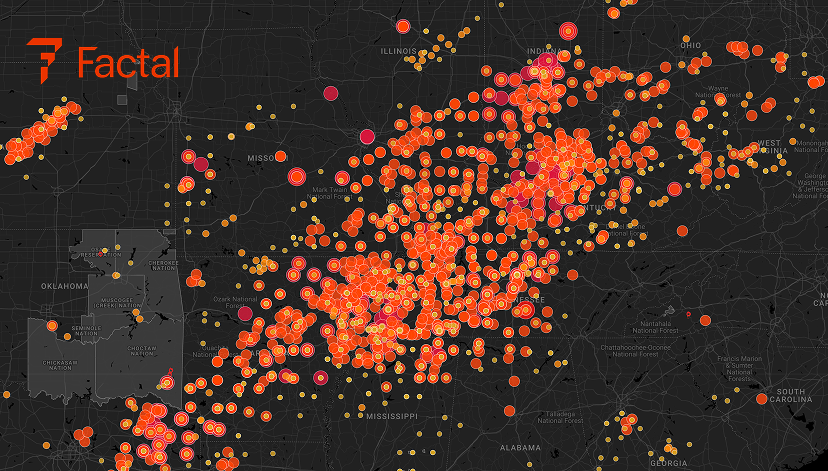
Tornadoes wreak havoc on the continental United States every year, causing widespread structural damage and killing dozens of people. Authorities say about 1,000 tornadoes impact the continental United States annually, 20 percent of which might be considered violent. The scope of tornado impacts can vary significantly year-to-year and can cause billions of dollars in damage. While tornadoes can happen anywhere in the world, the United States is the country most affected by them. Even still, they remain extremely hard to predict and verify.
No one knows this better than Factal North America Lead Theresa Seiger who has become the resident expert on tornadoes. She leads the editorial team when preparing for tornado season each year and covers their impacts across the country. During this interview, Theresa answers questions about what this involves.
Key takeaways
- Tornado alley is more of a tornado blob, expanding north, south and east.
- Tornadoes act with little warning
- Confirmation comes a day later, verification by Factal happens live
- Live, eyewitness video is vital, especially in rural communities
- Convective storms also bring floods, lightning and extreme hail
How are tornadoes impacting the United States?
Though we’re seeing the same average number of tornadoes each year, research has shown tornadoes more often strike in clusters, or outbreaks, within a shorter time-frame. At the same time, tornado activity is spreading beyond the Great Plains region (known as “Tornado Alley”) and Florida and the Gulf Coast (known as “Dixie Alley”), and into states like Alabama, Arkansas, Missouri and Indiana. Just recently, we saw a very damaging tornado in Indiana.
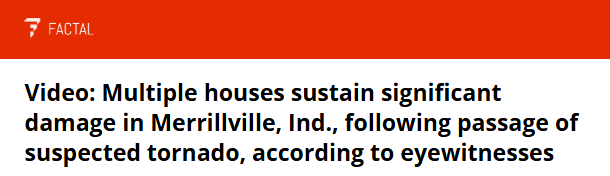
We’re also seeing tornadoes happening more often in cooler months outside of the traditional peak season, particularly on the Gulf Coast. Tornadoes are inherently unpredictable, even in a tornado-warned storm system.
In this interview Factal editor Sarah Burke interviewed Factal editor Theresa Seiger, two of Factal’s experienced breaking news editors.
What are the main challenges when covering breaking tornado news?
It is very fast-paced. Tornado outbreaks can begin — and end — very abruptly. It’s not unusual for more than one tornado to impact an area at a time, or for multiple, widespread areas to be hit in the same storm. Tornadoes give little warning on where or when they will strike, but can often occur during evening hours or overnight, making visual verification very challenging. We actively monitor eyewitness and storm chaser accounts, combined with what we’re seeing from authorities like the National Weather Service and local officials, to get the fullest picture possible in real-time.
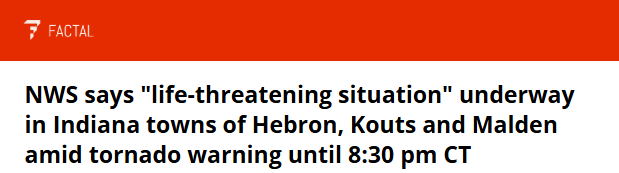
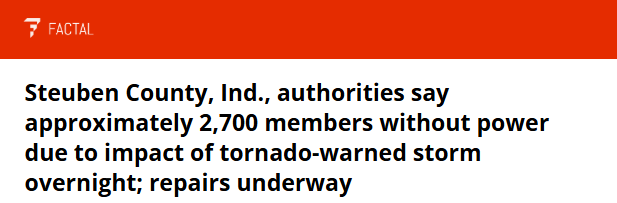
The aftermath of a tornadic storm can be very chaotic, and it can take authorities hours, or even days, to confirm the impacts, especially if the storm was in a hard-to-reach area. We might see widespread power outages. It can take time to reveal the full scale of damage.
How do you verify an actual tornado has touched down?
The work of verifying a tornado touchdown is typically done the day after a storm by the National Weather Service. They send out a team to survey the damage and determine the strength of the storm. This information is invaluable, but not always timely. When a storm is active, we look for people who actually have their eyes on a reported tornado. You will often see reports of “confirmed tornadoes” during storm coverage that are referring to apparent tornadoes visible on radar.
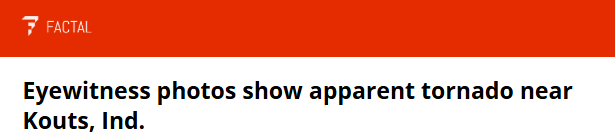
These can still be very dangerous winds inside a damaging storm system, even if NWS does not later confirm a tornado touched down.
How important is video and how do you verify it?
Video is instrumental in our coverage, especially when we’re looking at storms in more rural areas, where local media coverage might not be as robust. Storm chasers, who often stream live video, can give us early indications of a tornado and a sense of the general location. We’re always aware that we might be looking at AI-generated media on the job, and we’ve got some things we look out for with that in mind, such as, like, are we seeing other angles of this damage? Are we seeing similar reports from other reliable sources? Is this an area that we can find on a map, and how does it compare visually? We are constantly cross-checking and verifying.
What are the best sources for covering tornadoes?
There are lots of fantastic sources we regularly watch during storms, with the No. 1 being the National Weather Service. Local meteorologists can also be brilliant on the threats and impacts in their coverage areas. We run tailored searches against our sources and open searches against multiple social media platforms to find eyewitnesses who might be close to the storm. Active tornado coverage leans very heavily on eyewitness accounts, which can be tricky to verify, but essential in those early minutes.
How does tornado coverage compare to other natural hazards?
Tornadoes are a bit like earthquakes — you don’t get a whole lot of heads up on when or exactly where it will strike. This differs from hurricanes, where you can see a storm system inching closer towards a point on a map. The storms that bring tornadoes often bring other weather threats too — like flash floods and extreme hail — which can be deadly and damaging all on their own.
Verification is at Factal’s core — no matter the weather crisis
Tornadoes are a reminder that not every crisis comes with days of warning. In many cases, organizations have minutes to understand what is happening and determine whether it affects their people and operations.
Factal’s role as a verified risk intelligence platform is to cut through the uncertainty, verify what matters and deliver trusted information when decisions need to be made quickly. That’s true during tornado outbreaks, and it’s the same approach we bring to breaking events around the world every day. This is why enterprise security operations, intelligence analysts and business continuity specialists act 28 minutes faster when severe weather impacts their organization.
What is Factal?
Trusted by many of the world’s largest companies and more than 300 humanitarian NGOs, Factal is verified risk intelligence and collaboration that brings clarity to an increasingly noisy and uncertain world.
Powered by a hybrid of advanced AI and experienced journalists, Factal detects early signals, verifies critical details and assesses the potential impact at the speed of social media. From physical incidents to geopolitical developments, Factal offers the most trusted, real-time risk intelligence on the market.
Factal is also home to the largest security and safety collaboration network in the private sector. Members securely share information with other members in proximity to the same incident, both on Factal.com and the Factal app.
Learn more at Factal.com.