
 Factal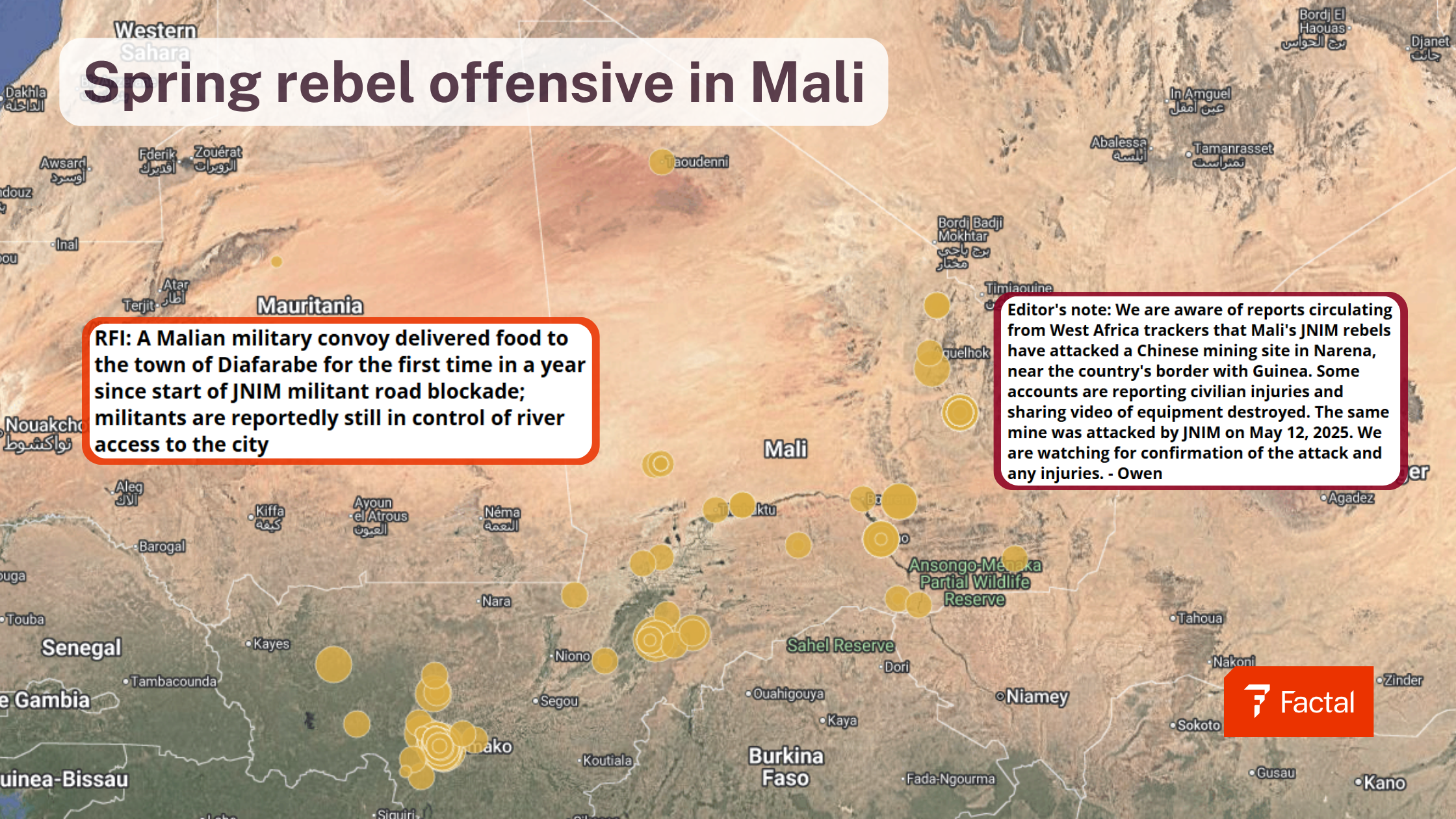
An unlikely coalition of separatist fighters and Al-Qaeda-linked jihadists have pushed Mali’s government junta to the precipice of collapse following a late April offensive that saw key northern towns fall out of their control.
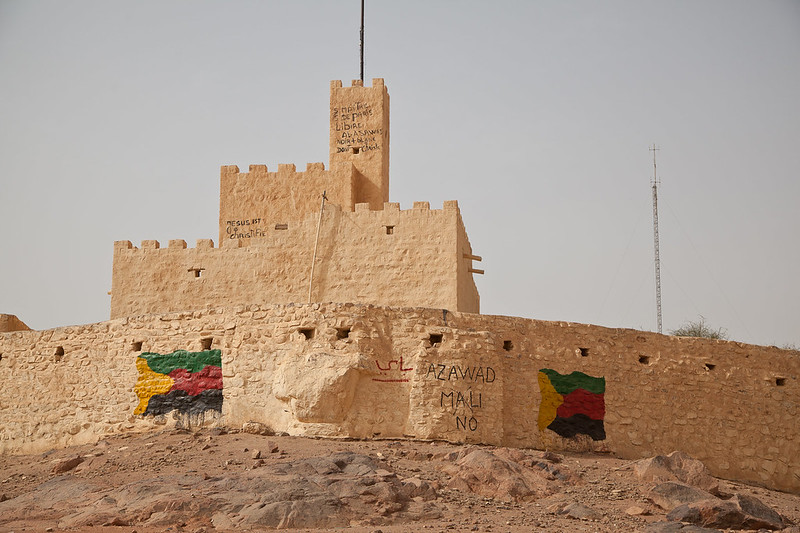
For more than a decade, the town of Kidal in northeastern Mali has served as a barometer for the success of separatist fighters, with control bouncing between militants and government forces.
Welcome to The Debrief, from the editors at Factal. Each month, we reflect upon an impactful yet underreported story that has significant regional or global implications. We'll examine how the story has progressed and how Factal's coverage has shifted to ensure we are always supplying our members with the most up-to-date, accurate, factual reporting.

If you like what you're reading, sign up to receive The Debrief in your inbox on the first of every month here.
“[It] has always been the urban heart of the Tuareg separatist movement,” said Factal Editor Owen Bonertz.
With the strategic — and symbolic — stronghold back in the hands of the separatist Azawad Liberation Front (FLA) and Al-Qaeda-linked Jama’at Nusrat al-Islam wal-Muslimin (JNIM) following a late April offensive, the country once again appears to be teetering on the verge of collapse, while new questions have been raised about the success of Russian support in securing the Sahel.
At first glance, the partnership between the FLA and JNIM would appear tenuous at best. The former seeks independence for their ancestral homeland, while the latter aims to impose strict Islamist rule over Mali. But, with a common foe in the junta that has ruled since 2020, and a shared interest in toppling the government and ousting their Russian partners from the frontlines of the conflict, the two sides formed a new coalition last year.
“If they were to head toward some sort of independence or autonomy or balkanization for the country, the Tuaregs would have their space and the Islamists would have theoretically have theirs.”
“They can kind of agree to work with each other, because they’re fighting over different territory, more or less,” Bonertz said.
FLA separatists have sought to break off the northern two-thirds of the country as an independent state, while JNIM has strategically targeted adding fighters from the Fulani ethnic group, who live in the center of the country and along the border with Burkina Faso.
“If they were to head toward some sort of independence or autonomy or balkanization for the country, the Tuaregs would have their space and the Islamists would theoretically have theirs,” Bonertz said.
While Kidal was the main town to fall into oppositional hands, the highly coordinated set of attacks over the final weekend of April also saw fighting in the northern town of Gao, the central cities of Mopti and Sevare, and instances of sustained gunfire on the outskirts of the capital Bamako. Defense Minister Sadio Camara was the victim of an apparent suicide truck bombing in the town of Kati, while military intelligence chief Modibo Koné was reportedly in poor condition following a separate attack, dealing significant blows to the country’s military leadership.
Russian fighters have withdrawn from Aguelhok and Tessalit, two other strategic northern locations, while abandoning equipment that suggests a haphazard exit and putting new tools in the hands of the insurgents. The equipment that militants have taken this time around is particularly advanced.
Separatist leaders say the capture of Kidal is “only the beginning” of their offensive, and have called on Russian paramilitary forces to withdraw from the country entirely.
“Politically, this is going to be a big test for the Alliance des États du Sahel.”
That appears unlikely even with the recent setbacks, as Russia’s Africa Corps continues to claim various strikes across the country in conjunction with the Malian armed forces, despite acknowledging that “the situation in Mali remains challenging.” While Russia was able to step into the vacuum left by the withdrawal of French troops several years ago, any broader aims that accompanied their arrival are now on the backburner.
“The goals are no longer counterinsurgency and building out the Russian mining industry, which is what it was when they felt more ambitious about it,” Bonertz said. “They don’t have illusions of doing that anymore. They instead just want to protect the junta regime.”
Also tasked with propping up the current Malian leadership are its neighbors and fellow junta-led governments.
“Politically, this is going to be a big test for the Alliance des États du Sahel,” Bonertz said.
The confederation, originally formed by Mali, Niger and Burkina Faso as a mutual defense pact in 2023, carried out “intense air campaigns” following the insurgent attacks, with the stability of the greater Sahel facing a new challenge with the latest unrest. That show of force is likely a necessity, as other jihadist groups view the situation in Mali as a potential harbinger for what they can accomplish.
In the coming months, both the junta and the coalition will likely be put to the test, as the government tries to maintain its tenuous grasp on power, while the still nascent FLA-JNIM partnership attempts to manage its newly-captured territory — and potentially go for more.
Militants reportedly set dozens of vehicles on fire near Bamako in the lead up to Eid, an apparent escalation of the fuel blockade JNIM imposed on the capital last year. In a country heavily dependent on those transports from neighboring countries, an increased emphasis on that effort could serve as another destabilizing blow against the junta.
Written by Joe Veyera. Edited by Jillian Stampher.
Further reading:
- Review Factal’s coverage of Mali’s rebel offensive on our topic page (members link)
- Watch this episode of Africa Matters produced by TRT World, the international outlet of Turkey’s public broadcaster, that covers the April offensive in Mali
- Read this analysis from the Atlantic Council’s Africa Center on what comes next for both the separatists and the government junta in the wake of the latest attacks
Thanks for reading! If you enjoyed this edition, sign up here to receive The Debrief in your inbox on the first of every month.
Verified risk intelligence by Factal supports the world’s largest corporations and 300+ humanitarian aid NGOs, helping them act faster in a world of rumors and generative misinformation. Facts save lives.
Try Factal for free or talk with our sales team (sales@factal.com) for a demo.