
 Sarah Burke
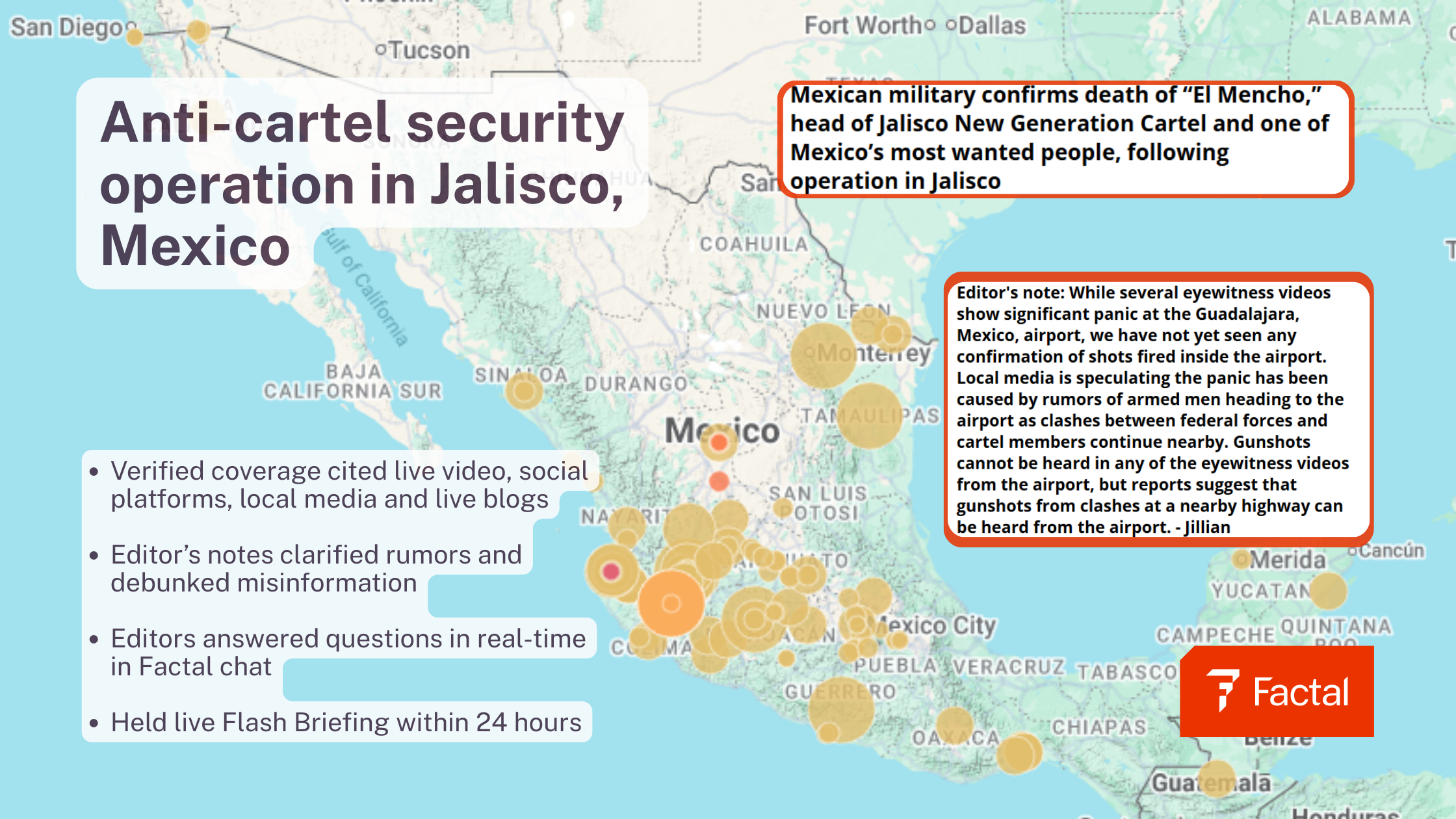
World Cup security preparations came into sharp focus this week when violent unrest erupted across Mexico’s Jalisco region after a federal anti-cartel operation – backed by U.S. intelligence – led to the death of “El Mencho,” boss of the CJNG cartel. Jalisco’s capital, Guadalajara — one of the official host cities for 2026 Men’s FIFA World Cup — became the scene of widespread street violence including blockades, fires and gunfire, while a state-wide stay-at-home order, or “code red,” brought civilian activities to a near-standstill. Dozens of cartel operatives and Mexican security forces were killed in the fighting.
The impacts were immediate. Airlines quickly suspended flights to area airports and foreign governments, including the United States, Canada and the United Kingdom, quickly updated advisories to discourage travel to the region. FIFA has said it is monitoring the situation “closely” and remains in constant contact with authorities.
“The likelihood of the event itself or visitors being specifically targeted in Jalisco is remote,” says Alex Moore, senior editor at Factal. “But a relative uptick in violence, specifically in major areas like Guadalajara, raises the overall risk to travelers, especially with disruption from cartel blockades.”
In about 100 days, the first match of the World Cup — the world’s most popular sporting event — will take place in Mexico City. Over the next six weeks, 104 games — nearly 170 hours — of soccer will be played across 16 cities in the United States (11), Canada (2) and Mexico (3). On any given day there might be games taking place in Los Angeles, Vancouver, Miami, Guadalajara and Philadelphia. This World Cup is a mega event on a continental scale.
“This is the first time the World Cup has been held jointly by three nations. Major sporting events can be a logistical headache to follow when there are several venues spread across one country, much less three,” says Joe Veyera, North America lead at Factal. “This has an added layer of complexity. FIFA will try to standardize security measures but we’ll have to wait and see what differences emerge, if any.”
“This is the first time the World Cup has been held jointly by three nations. Major sporting events can be a logistical headache to follow when there are several venues spread across one country, much less three.”
says Joe Veyera, North America lead at Factal.
Logistical complexity — and very expensive tickets — makes attending this year’s competition particularly challenging already for sports fans. For risk intelligence professionals too, this tournament will push the limits of experience and require a multi-faceted approach. Jalisco is another reminder that incidents can move quickly — as can rumors — and verified information is of critical importance.
While it remains to be seen whether insecurity in Jalisco will be prolonged, the rapid descent into open conflict between the Mexican authorities and the cartels will be unsettling for both organizers and fans.
“Its hard to say precisely where this goes next but it we could continue to see an uptick in violence, likely centering around Jalisco and Michoacan,” says Moore. “This has so far manifested mainly in CJNG clashing with the Mexican state, though could metastasize into clashes with rivals such as the Sinaloa or Los Viagras cartels.”
Factal’s 24/7 team of multilingual editors continue to support members with breaking news coverage of cartel violence across Mexico on our site, our app, as well as through live flash briefings and our members-only chat rooms. In addition to being poised for unpredictable events, Factal editors will be preparing for a number of known risks across the extremely wide landscape of the 2026 FIFA World Cup.
In the United States the ongoing government shutdown is threatening preparations in its 11 host cities, amid uncertainty over how ICE and the anti-ICE protest movement might manifest during the tournament.
“I think the biggest concern for U.S. host sites is what presence immigration enforcement decides to have, and that’s probably the biggest potential for protests as well. ICE has said it will be a “key part” of security. Its presence alone has the potential to deter visiting fans who have concerns they’ll be detained even if they’re in the country legally.”
Meanwhile there is a partial government shutdown impacting DHS budgets and more than $600 million allocated by Congress for World Cup security preparations is held up with it. Host cities are sounding the alarm.
“This has real consequences for security preparations in host cities. With just over 100 days to go before the start of the tournament, local officials are now raising concerns that the impact could be catastrophic for planning and coordination if the money isn’t distributed soon,” Veyera says.
The World Cup is the most popular sporting event in the world, with millions set to make the journey to the U.S, Canada and Mexico and billions more watching from home.
“With so many eyeballs on the tournament there’s added pressure on hosts to get everything right,” Veyera says. “Any problems are magnified, so you can imagine how important preparation is.”
Here is some of Factal will be watching:
- Immigration and border disruption: Authorities in all three host nations are warning ticketholders to plan well in advance for a smooth travel and immigration experience. U.S. officials expect between five and seven million international visitors to the United States during the World Cup. ICE will be closely involved in security at venues and transport hubs. It is unclear still exactly how this will manifest, but the lack of clarity already has some people — and lawmakers — on edge. At least four qualifying teams are on the visa ban list: Iran, Haiti, Senegal and Ivory Coast, and while players and coaches will get a temporary exemption, fans will not. The White House Task Force for the tournament said “security and hospitality can and will coexist” despite fears that people will be deterred from attending in person. Some Canadian lawmakers want to ban ICE from attending fixtures in Vancouver for fear of political friction.
- Protests, violence and enhanced policing: The United States has seen widespread ant-ICE protests in Minnesota, Oregon, California and Illinois since the Trump administration first began a crackdown last year. These have become violent at times, with several high-profile shootings attracting global outrage. Political protests over Iran or Israel/Gaza are also frequent. The U.S. government is funding its 11 host cities to the tune of tens of millions of dollars to supplement public safety preparations, including overtime, cybersecurity and emergency response for what one Kansas City official called “a 24 hour operation for 39 days”. But these funds are still held up by a partial government shutdown and city officials are beginning to sound the alarm. In Mexico there will be renewed focus on cartel-linked violence. In all three co-hosting countries, hooliganism — always a concern whenever international soccer fans are gathered in large groups — will be a concern for public safety.
- Drones: The Department of Homeland Security and the White House Task Force said more than $1 billion has been allocated to securing the tournament, including $500 million toward a counter-drone technology and training grant program for host cities. DHS budgets are still subject to a partial government shutdown meaning some of this money remains undistributed. U.S. and Mexican authorities are both concerned about hostile drones and airspace monitoring capabilities. New systems and training hope to help protect venues and transportation hubs from UAV risks. Other new technological approaches include robotic surveillance dogs being rolled out for venues in Mexico.
- Cybersecurity and sabotage: Recent mega events like Milan-Cortina and the Paris 2024 Olympics were subject to cyberattack operations and sabotage by hostile actors, some linked to Russia. While this type of risk tends to be more significant in Europe, any large international event will be actively preparing for hybrid attacks, even in North America. Of particular concern will be transportation — trains, roads, airports — and technological systems like power, communications and digital services, especially those supporting the events. There have been a number of cyberattacks aimed at political, government and defense targets in the United States and Canada in recent years. Many of these have been linked to China.
What Factal members should expect
Factal’s 24/7 editorial team will continue to track incidents across Mexico, US, and Canada (and the globe), to ensure members are aware if any threats or disruptions arise in real-time. Members can also download an asset pack with stadiums, training facilities and official hotels to stay aware of the risks associated with business or bleisure travel (contact your member success manager). For members using the Factal Travel Risk Management solution with International SOS, this partnership enables real-time travel notifications throughout the event, which is an important resource as millions of travelers move across North America during peak wildfire and tornado seasons.
Top photo: FIFA President Gianni Infantino and U.S. President Donald Trump onstage during the FIFA World Cup 2026 official draw at the John F. Kennedy Center for the Performing Arts in Washington, D.C., December 5, 2025. (Photo: Freddie Everett / State Department)
What is Factal?
Trusted by many of the world’s largest companies and more than 300 humanitarian NGOs, Factal is verified risk intelligence and collaboration that brings clarity to an increasingly noisy and uncertain world.
Powered by a hybrid of advanced AI and experienced journalists, Factal detects early signals, verifies critical details and assesses the potential impact at the speed of social media. From physical incidents to geopolitical developments, Factal offers the most trusted, real-time risk intelligence on the market.
Factal is also home to the largest security and safety collaboration network in the private sector. Members securely share information with other members in proximity to the same incident, both on Factal.com and the Factal app.
Learn more at Factal.com.