
 Factal
A gold medal performance for the country’s national team in men’s soccer at the Asian Games secured an exemption from military service for its players. The responses from some players now have the defense ministry considering rolling back or abolishing the exemption system for athletes and entertainers entirely.
For most athletes, a gold medal represents the peak of their sport: a testament to years, if not decades, of training to reach the top.
But what if that weren’t the real prize?
Welcome to The Debrief, from the editors at Factal. Each month, we reflect upon an impactful yet underreported story that has significant regional or global implications. We’ll examine how the story has progressed and how Factal’s coverage has shifted to ensure we are always supplying our members with the most up-to-date, accurate, factual reporting.
If you like what you’re reading, sign up to receive The Debrief in your inbox on the first of every month here.
As members of South Korea’s Asian Games-winning men’s soccer team celebrated their victory over Japan in early October, their excitement was over more than a piece of hardware around their necks. They had avoided 18-to-21 months of mandatory military service under a controversial exemption given to high-performing sportsmen and artists. Instead, they would receive just three weeks of basic training, and need to complete 544 hours of community service over the course of almost three years.
While past winners have typically tread lightly around what has long been a sensitive topic for the general public, several players showed less tact. The team’s captain, Lee Gi-hyuk, was forced to apologize after holding up his medal and proclaiming he was “not going to the military,” while Yang Min-hyeok walked back comments suggesting the exemption served as payment for their performance. Park Seung-soo posted a locker room photo wearing a military discharge cap, prompting yet another apology.
Concerns over the program were nothing new, but the overt admissions of motivation prompted significant outcry and renewed calls to overhaul or dismantle the exemption process.
“It’s definitely not the first time this [exemption] was called into question, but people weren’t as obvious about these remarks,” said Factal Editor Hua Hsieh. “The reason that the controversy was so bad this time is probably because they made such public comments.”
While the general public found their responses to be in poor taste, it’s easy to see why the opportunity would prompt such excitement on their part. For young athletes, losing years of their prime to military service can derail their careers or diminish their earning potential.
“The reason that the controversy was so bad this time is probably because they made such public comments.”
Factal Editor Hua Hsieh
And while the postgame remarks drew significant scorn, others took issue with players who received the exemption despite playing only a few minutes across five games, and two backup goalkeepers who didn’t log a single second of action during the tournament.
The backlash comes as South Korea faces a shrinking pool of enlistment-age men to perform military service, a problem that shows few signs of easing in the coming years as the country continues to grapple with one of the world’s lowest birth rates. From 2019 to 2025 the number of active-duty military members dropped 20 percent, prompting many to raise questions if the athlete exemption has now outlived its useful life after more than five decades in practice.
At its launch in the early 1970s, the program was meant to allow certain artists and athletes to continue their pursuits in the name of national prestige, on the heels of North Korea’s first Olympic gold medal.
“This was created in a time where the competition with North Korea on a global stage was really fierce,” Hsieh said. “Sports and art performances were seen as a symbol of national power.”
The country’s showing in the Olympics improved in the following years, from a single silver medal in 1972 to 33 medals (12 gold) by 1988. Anywhere from 20 to 30 medals is now the standard showing at the summer games. From a pure athletic success standpoint, there’s at least a correlation between the launch of the exemption and the number of medals won. Causation is harder to prove, but the remarks from the men’s soccer team suggest it now serves as a significant motivator.
In its current form, the program still leaves many athletes in the lurch, excluding high-level competitors in sports outside traditional international competition. Others have criticized how it treats entertainers, noting that classical musicians and ballet dancers had several paths to earn the exemption, while all seven members of the popular K-pop group BTS completed public service (all but one in the military), merely deferring their enlistment as part of a carveout approved by lawmakers in 2020.
“This was created in a time where the competition with North Korea on a global stage was really fierce. Sports and art performances were seen as a symbol of national power.”
Factal Editor Hua Hsieh
While this year’s Asian Games brought renewed scrutiny to the athlete exemption, it’s not the first time concerns have been raised. South Korean officials floated the idea of amending the rule after the event in 2018, with polling at the time showing public sentiment evenly divided over whether to scale up the program.
Now, a full review is underway once more, with Defense Minister Kang Shin-chul saying the goal is to “ultimately abolish” the system. A preliminary plan is expected in the coming weeks.
“Details are very limited, and we cannot say what exactly will happen at this moment,” Hsieh said.
Reports from South Korean media suggest that officials may look to tighten the exemption criteria, while allowing others to postpone their military service into their late 30s. In the meantime, as athletes eye the 2028 summer games in Los Angeles, they’re likely hoping to win more than a medal.
Written by Joe Veyera. Edited by Jillian Stampher and Bada Kim.
Further reading:
- Read about the backlash faced by the men’s national soccer team in The Athletic (subscription required).
- Watch this brief breakdown of the situation from the BBC’s Sophie Jeong.
- See how the debate on military exemptions has evolved from this 2018 episode of “Foreign Correspondents,” a talk program produced by South Korean international broadcaster Arirang TV.
Thanks for reading! If you enjoyed this edition, sign up here to receive The Debrief in your inbox on the first of every month.
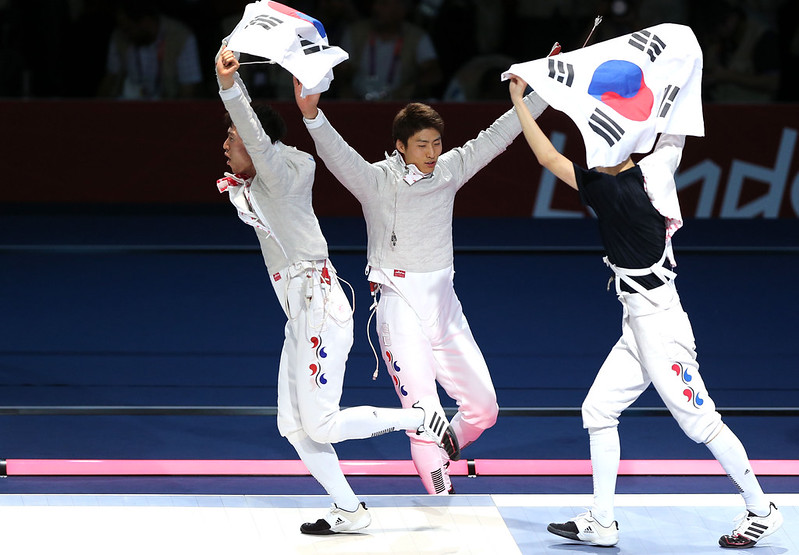
Top photo: Members of South Korea’s men’s team sabre roster celebrate their gold medal victory at the 2012 London Olympics. (Korean Culture and Information Service / Korean Olympic Committee / CC BY SA 2.0)
Verified risk intelligence by Factal supports the world’s largest corporations and 300+ humanitarian aid NGOs, helping them act faster in a world of rumors and generative misinformation. Facts save lives.
Try Factal for free or talk with our sales team (sales@factal.com) for a demo.