
 Factal
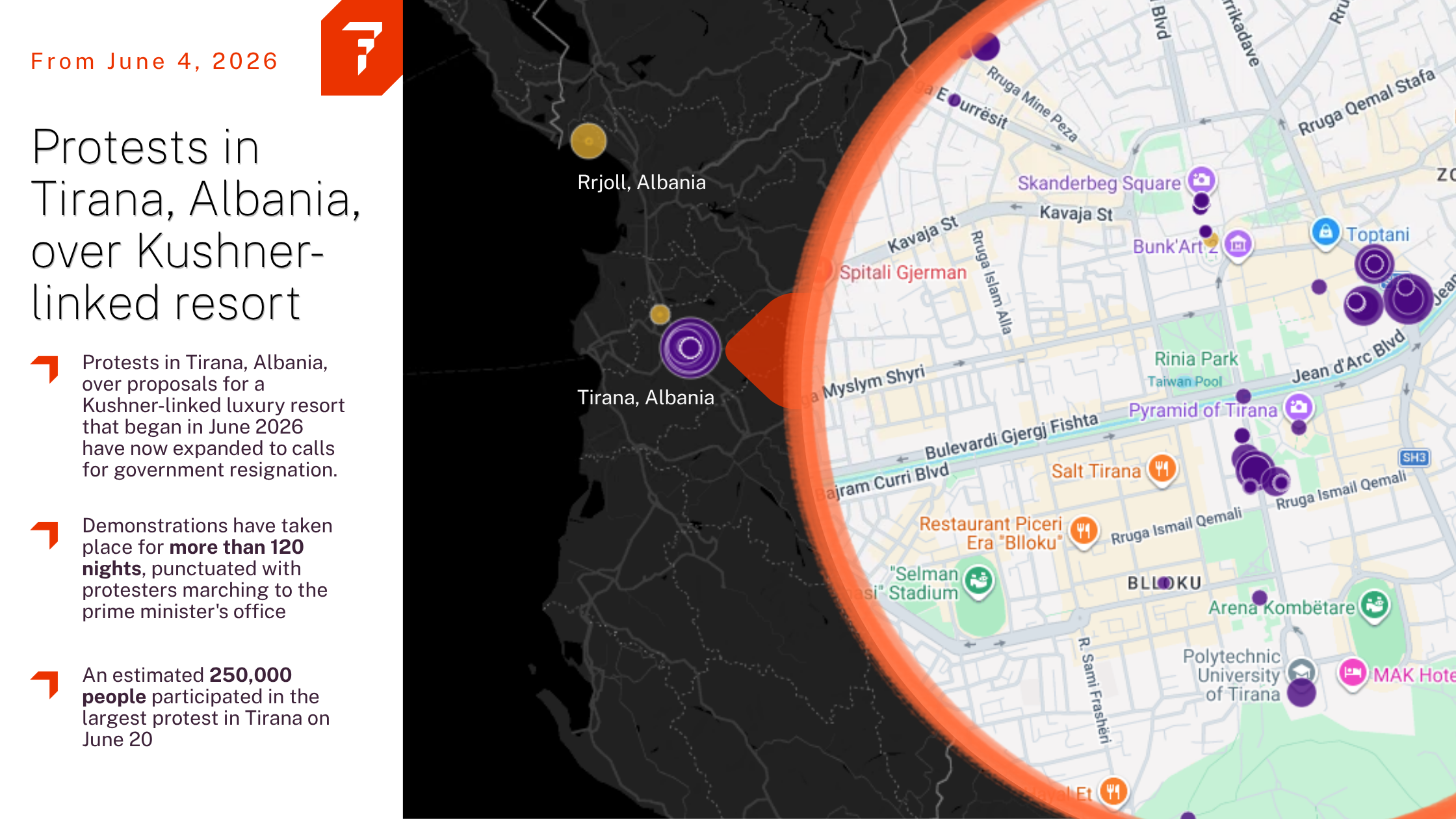
Environmental concerns over a proposed luxury development in Albania have sparked nightly protests on the streets of Tirana, and escalated to calls for the resignation of Prime Minister Edi Rama. Whether that groundswell is enough to topple the government remains to be seen.
Endangered birds, real estate developers, protests: It has all the makings of a movie.
Welcome to The Debrief, from the editors at Factal. Each month, we reflect upon an impactful yet underreported story that has significant regional or global implications. We’ll examine how the story has progressed and how Factal’s coverage has shifted to ensure we are always supplying our members with the most up-to-date, accurate, factual reporting.
If you like what you’re reading, sign up to receive The Debrief in your inbox on the first of every month here.
But this isn’t the plot of 2006’s Hoot, it’s a very real crisis plaguing Albania. Luxury tourism plans for the country’s protected Adriatic coastal wetlands have sparked months of backlash in capital Tirana, where protesters have gathered nightly for more than 100 days. Activists are hoping to force the Balkans to decide what holds more value:
An untouched natural coastline, or an influx of visitors and the revenue they bring?
Albania is already experiencing a tourism boom, with approximately 12 million arrivals in 2025, an increase of nearly 94 percent from 2019. As the country competes with the likes of Greece and Croatia for visitors, new hotels and resorts have sprouted, hoping to capitalize on the burgeoning industry.
“[Tourism] has over the last couple of years — especially post pandemic — really exploded,” said Factal Europe Lead James Morgan. “And there isn’t much in the way of what is powering the Albanian economy at the moment, but tourism has become a real cornerstone of their economic development.”
Enter Jared Kushner.
“In the sense that you’re taking areas that were ostensibly for the public, that belonged to Albania, that were protected areas, and you’re not only developing them in a very untransparent way, but also you’re developing them for a very, very tiny, exceptionally wealthy minority.”
Factal Europe Lead James Morgan
Plans first emerged in 2024 from President Donald Trump’s son-in-law for what is now a $1.6 billion proposal featuring hotels, apartments, villas, and a marina in the area of the protected Vjosa-Narta delta, along with the nearby uninhabited island of Sazan. Kushner’s wife, Ivanka Trump, said their interest stemmed from a Mediterranean vacation that left them “captivated” and that they “developed the opportunity to help realize its potential.”
“What I think is different about the Kushner project is that it’s aimed at much more wealthy clients,” Morgan said. “It’s really been billed as this luxurious development that’s aimed towards a more high-end customer, and I think that has particularly angered the populace of Albania. In the sense that you’re taking areas that were ostensibly for the public, that belonged to Albania, that were protected areas, and you’re not only developing them in a very untransparent way, but also you’re developing them for a very, very tiny, exceptionally wealthy minority.”
The site is a key nesting ground for loggerhead sea turtles, a habitat for the endangered Mediterranean monk seal, and a key stop for migratory birds on the Adriatic Flyway — hence the “Flamingo Revolution” moniker. Concerns mounted in late May, as bulldozers and excavators rolled in, clearing land before requisite environmental reviews had been conducted. Video of an activist being dragged away by security on site brought the situation to a head.
“[Those pictures] became symbolic of the impunity that some of these development projects enjoy in Albania at the moment,” Morgan said.
For more three months protesters have taken to the streets of Tirana. But what began as pushback over environmental impacts quickly evolved into broader anti-government demonstrations and calls for the resignation of Prime Minister Edi Rama. Beyond the development itself, protesters have taken aim at what they believe it signifies: a government beholden to the wealthy at the expense of all else. To that end, the country’s anti-corruption office opened an investigation in June into 2024 legislative changes that removed restrictions on construction within ecologically sensitive zones.
“In essence, for the Albanian electorate, it’s not just that this is an incredibly beautiful, environmentally rich area that’s being developed, it’s also, ‘Hold on a second, this could actually put the brakes on our accession into the EU,’ which is something that the Albanian public have been voting for for years”
Factal Europe Lead James Morgan
Some are concerned that the country’s potential accession to the European Union may be at risk, with the European Parliament adopting a resolution in June calling for an immediate moratorium on new permits and construction in Albania’s protected areas. For voters that have waited more than a decade, the idea that a luxury development could jeopardize the country’s application is a bitter pill to swallow.
“In essence, for the Albanian electorate, it’s not just that this is an incredibly beautiful, environmentally rich area that’s being developed, it’s also, ‘Hold on a second, this could actually put the brakes on our accession into the EU,’ which is something that the Albanian public have been voting for for years,” Morgan said.
Proponents, including Rama, say the project is the kind of investment the country needs, and have responded to calls for his ouster by claiming at least some of the opposition to the plans has been amplified by foreign actors. That echoes previous claims of an Iranian-backed campaign sparked by the country’s sheltering of an opposition group.
While protests continue nightly — occasionally escalating to clashes with police — the public groundswell may not be enough to do much more than delay the project.
“I think it’s come too far already, and already has enough investment and enough momentum behind it to keep going,” Morgan said.
As for Rama, the prime minister has shown little interest in stepping aside, with the next parliamentary elections not until 2029.
Written by Joe Veyera. Edited by Jillian Stampher.
Further reading:
- Review Factal’s coverage of the Flamingo Revolution on our topic page (members link)
- Watch this episode of Dateline, an international current affairs program produced by Australia’s SBS, on the situation in Albania.
- Listen to this interview from CBC’s The Current with freelance reporter Alice Taylor.
Thanks for reading! If you enjoyed this edition, sign up here to receive The Debrief in your inbox on the first of every month.
Top photo: Protesters filled the streets of Tirana, Albania, on June 13, in demonstrations that have now continued nightly for more than 100 days. (Photo: Albinfo / Wikimedia Commons / CC BY 4.0)
Verified risk intelligence by Factal supports the world’s largest corporations and 300+ humanitarian aid NGOs, helping them act faster in a world of rumors and generative misinformation. Facts save lives.
Try Factal for free or talk with our sales team (sales@factal.com) for a demo.