
 Factal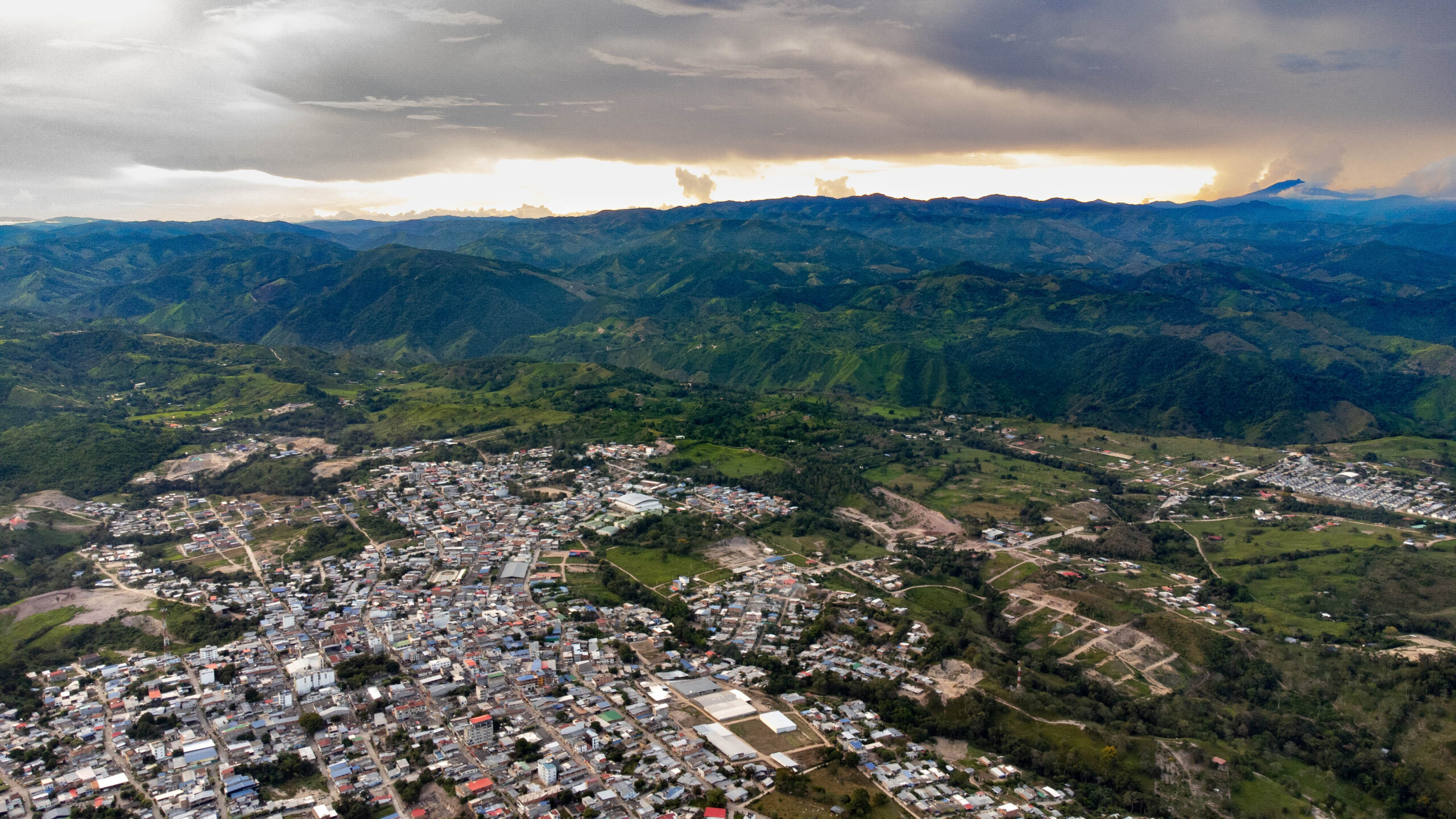
As Colombia’s former guerrilla and paramilitary groups battle for control of territory lush with narcotic crops, gold, minerals, and illicit trade routes, millions of Colombians are left unprotected and trapped with each flare-up and expanding front in a war that shows no signs of slowing.
Since late June, thousands of Colombians in Sur de Bolivar have been suffering in the heavy fighting between armed criminal organizations for control of the region’s rich mineral deposits. Many were trapped, while others fled on foot to state capitals, carrying whatever they could. Weeks of intense clashes left locals without food, fuel, or even permission to travel. The military force deployed to intervene was outnumbered, two to one by some accounts, and came under deadly aerial attack.
It remains unclear whether calm has returned since the June 21 armed strike called by the guerrilla group Ejército de Liberación Nacional (ELN) and paramilitary Gaitanist Self-Defense Forces of Colombia, commonly known as Clan del Golfo. Both groups have long had an interest in Sur de Bolivar, a region offering a corridor for narcotics, and under it, rich reserves of gold and rare minerals. The military claims its response is ongoing, and that civilians began returning as of Aug. 17, but the number of impacted Colombians is also unknown. Colombia’s government has historically kept poor records in rural and conflict-affected areas.
Similar armed strikes have impacted Choco in Pacific Colombia and Guaviare in the Amazon region, in part of a broader trend.
“The recent clashes we’ve been seeing are [part of] an ongoing war for territorial control, and it’s happening across the country,” Factal senior editor and Latin America regional lead Irene Villora said. “It [involves] multiple guerrillas and paramilitary groups … vying for control of illegal economic activities.”
By July 2025, violence had surged. Compared to the first half of 2024, the number of Colombians impacted by displacement and confinement spiked by more than 333%. The scale of unrest in the country is such that it has spread across the Pacific departments and the Amazon–Orinoquía region, extending through the Caribbean and into the northwestern regions bordering Venezuela.
“The ones who have the most to lose are not the people in the capitals. Colombia has a massive proportion of the population living in rural areas.”
Most of the violence is driven by armed groups, some of which originated as guerrilla movements with well-defined ideologies, such as Fuerzas Armadas Revolucionarias de Colombia (FARC) or ELN, and others that emerged as a paramilitary response to the insurgents. At its peak, FARC’s ranks were once numbered in the tens of thousands, but after the 2016 peace deal with the Santos administration disintegrated, the group splintered, and many factions returned to armed struggle, often against each other, while the ELN consolidated power and gained ground.
“We have [seen] more actions by the ELN across the country… [than] a few years ago, and they have gained more notoriety in different fronts across the country,” Villora added.
A recent example of this shift can be seen in Catatumbo, a region of Norte de Santander on the border with Venezuela, where the ELN has taken over significant portions of coca-producing regions that were previously under FARC control. Villora says this takeover has been facilitated, in part, by the ongoing fragmentation of FARC.
The fight for Catatumbo in January was particularly brutal. Fueled by laundered US dollars and contraband trade, it left dozens of people dead and displaced more that month than the national total for all of 2024. The government sent in troops and claimed that more than 100 FARC fighters surrendered, but the unrest laid bare failures of the 2016 peace deal and the state’s inability to establish a meaningful presence in rural areas where neglect and illegal economies go hand in hand.
“The issue is [that] the groups are all over the country … not restricted to just a few regions. The Peace Commission from Colombia says there are 12 active fronts across the country at the moment, and that covers most of the country,” Villora said. “The ones who have the most to lose are not the people in the capitals. Colombia has a massive proportion of the population living in rural areas.”
In 2025 alone, nearly one million people lost access to essential services, food aid and healthcare. The armed strikes in Amazonas, Guaviare, Choco, and beyond have upended rural economies, with locals unable to farm, fish, or hunt.
Attacks in major Colombian cities remain relatively rare, compared to the era of large cartels, but recent strikes, like the Aug. 21 attack on an air base in the western city of Cali killed at least 19 people and injured dozens more, signal the potential for escalation. FARC factions, including the one led by Ivan Mordisco, have used urban strikes to assert power.
“How internal wars and clashes impact the population widely varies depending on the region. In some regions the groups are fighting for sea access for drug trafficking, or control of mines or minerals. Some regions, they’re fighting because there’s large crops of marijuana or because there are large crops of coca leaf…The geography is [also] widely different, and getting to some of these areas is so difficult that it also impacts the government response, even though you would think the government should be able to reach everywhere.”
“Violence is expected to remain at similar levels in the coming months, and we can’t [rule out] escalation.”
President Gustavo Petro’s administration is under pressure. His “Total Peace” policy, once the centerpiece of his campaign, is now widely seen as little more than a slogan. Multiple scandals have weakened his position: his finance minister resigned in 2024 after being accused of stealing funds from the disaster relief agency, and his son was charged with money laundering. He now faces internal efforts to remove him from power.
“The problem with [Petro’s] government is that he has been really hard to read, especially after the Total Peace plan started to show failings. He has been in a bit of a difficult situation trying to make this government survive while being attacked by the opposition,” Villora said. “It’s not been an easy ride for his government, but at the same time, they’ve done a terrible job at communicating what the actual plans are, especially because the flagship of his campaign, his flagship policy, was the Total Peace plan.”
Petro’s challenges aren’t limited to Colombia. In addition to thriving coca production and growing conflict, he must also contend with Venezuela’s longstanding support for Colombian armed groups.
The ELN’s ties with Colombia’s eastern neighbour date back to at least the 1980s; a relationship that has enabled the group to operate on both sides of the border and grow in power. ELN positions in Venezuela’s Apure provide protection as it moves illegal goods, and a 2022 investigation found that the ELN has a presence in at least eight Venezuelan states, including Anzoategui on the Caribbean coast.
“The former Venezuelan government of Hugo Chavez favoured FARC … but when Nicolas Maduro came into power in 2013 after Chavez’s death, he favoured relations with the ELN. The recent ELN expansion and growth is partly thanks to their [alliance] with the Maduro government.”
The US has gotten more involved. Accusing Maduro of leading “narco-terrorist group” Cartel de los Soles, the Trump administration placed a $50 million bounty for his capture and deployed eight warships to the Caribbean and Pacific in an anti-narcotics operation in late August, raising the spectre of a US military attack on Venezuela. Maduro responded by deploying 15,000 troops near the Colombian border and mobilizing 4.5 million so-called militiamen across Venezuela.
Brazil and Colombia have accused the US of interventionism, but have said they will not join Colombia in any armed cooperation. Colombia’s interior minister said that there is “no trace of military agreement” with Venezuela, even as tensions rise in the region as US warships inch closer to the region.
But inside Colombia, even as the military build up in the southern Caribbean captures global attention, little has changed. The conflict grinds on, and the Petro administration has offered no new strategy.
“Violence is expected to remain at similar levels in the coming months, and we can’t [rule out] escalation,” Villora said.
Most of the fighting remains concentrated in rural areas, where armed groups have the most to gain from drug routes, illegal mining, and weak state presence, but Villora explains the recent attacks in Cali suggest the front lines may be shifting. If the conflict continues to bleed into major cities, Colombia could soon face a far more destabilizing phase of its ever expanding war.
Written by Halima Mansoor. Edited by Bada Kim.
Further reading:
- Review Factal’s coverage of attacks in Colombia on our topic page (members link)
- Review Factal’s coverage of US deployment of warships off Colombia and Venezuela’s coasts on our topic page (members link)
- Click through this interactive map that shows the expansion of FARC in Colombia between 1964 and 2016
- Read this FND report on the 12 active fronts of fighting dominated by armed groups in Colombia
- This investigative report dives into the rise of the ELN in Venezuela
Thanks for reading! If you enjoyed this edition, sign up here to receive The Debrief in your inbox on the first of every month.
Top photo: Santa Rosa was one of four villages under an armed strike by ELN guerrilla and Clan del Golfo paramilitary fighters in Sur de Bolivar, Colombia, from June through at least mid-August. The city, as seen on Nov. 8, 2023, faced a blockade that prevented the entry of basic supplies such as medicine, food, or fuel into the area. (Photo: Monkeyelgrand/WikiMedia /CC SA 4.0)

Factal gives companies the facts they need in real time to protect people, avoid disruptions and drive automation when the unexpected happens.
Try Factal for free or talk with our sales team (sales@factal.com) for a demo.