
 Factal
Welcome to Factal Forecast, a look at the week’s biggest stories from the editors at Factal.
We publish our forward-looking note each Thursday to help you get a jump-start on the week ahead.
Week of Oct. 10-17
A Look Ahead
Oct. 9 China Premier Li Qiang to visit North Korea
A Chinese delegation including Premier Li Qiang will arrive in North Korea on Thursday to participate in the anniversary celebrations for the ruling Worker’s Party of Korea.
What’s happened so far
The visit will last until Oct. 11, a day after a planned large-scale military parade to commemorate 80 years since the founding of the sole existing party in the country. A Russian delegation led by United Russia party Chairman Dmitry Medvedev is expected to attend. Vietnam and Laos delegations have also confirmed attendance after periods of 20 and 14 years respectively of no visits to North Korea from leaders of either country. The Chinese Foreign Ministry has expressed the government’s wishes to strengthen communications and deepen partnerships with North Korea during this visit.
The impact
Amid recent efforts to raise his diplomatic profile, North Korea’s President Kim Jong Un attended a military parade in Beijing in September on President Xi Jinping’s invitation to mark the 80th anniversary of Japan’s defeat after World War II. He also wrote a letter to Russian President Vladimir Putin earlier this week for his birthday, expressing the alliance between both countries would establish a “multi-polarized world order” beyond contributing to bilateral relations. South Korea has expressed hopes that China’s relations with its northern neighbor will contribute to denuclearization.
Oct. 12 Portugal local elections
Portuguese voters will elect their local representatives on Sunday, just months after a general snap election that saw Prime Minister Luis Montenegro consolidate his power.
What’s happened so far
Portugal has seen a period of political turmoil ever since former Prime Minister Antonio Costa, now head of the European Council, resigned over a corruption scandal, from which he has since been cleared. The country faced two general elections after that, with Democratic Alliance (AD) — a coalition between the Social Democrats (PS) and the People’s Party (CDS) — winning both votes without a majority. In the last local elections in 2021, the Socialist Party was in power and won most seats. Since then, the party has dropped to become the third largest party, after the far-right Chega became the main opposition in parliament.
The impact
Following the trend of the last general elections, AD is projected to win the majority of seats on Sunday, consolidating its power, but PS is expected to still come in a close second. Chega is likely to continue its growth trajectory, and could become the surprise of these elections once again, securing its first-ever municipality.
Oct. 12 Cameroon presidential election
On Sunday, more than 8 million voters in Cameroon will elect their president for the next seven years.
What’s happened so far
Cameroon’s incumbent president, 92-year-old Paul Biya, announced his bid for an eighth term in July amid calls for him to step aside after 43 years in power. In 2008, Biya signed a constitutional amendment removing a two-term limit for the presidency. If elected again, Biya could stay in office until he is nearly 100. In August, Cameroon’s constitutional council barred main opposition candidate Maurice Kamto from running in the election. Biya is set to face several challengers in this year’s election, including two of his long-time allies, former Tourism Minister Bello Bouba Maigari and former Employment Minister Issa Tchiroma Bakary, both of whom resigned to run in the hope of succeeding Biya.
The impact
Despite concerns about Biya’s health and criticism from domestic and international communities over the many irregularities in Cameroon’s past elections, many analysts say Biya is likely to stay in office due to the established clientelism, flawed electoral system, a divided opposition and a loyal army.
Oct. 12 U.K. begins adopting EU digital border system
The European Union’s new Entry/Exit System (EES) will kick off Sunday, bringing changes to requirements for British and other non-EU citizens travelling into the Schengen area.
What’s happened so far
U.K. passport holders traveling into the EU for a short stay — a 90-day limit for every 180 days — will be required to register their biometric details on or before arrival at Schengen borders. Travelers will need to submit fingerprints and have their photo taken at dedicated booths. The system will replace manual passport stamping upon full implementation. It will not be necessary to provide any additional information before traveling into a Schengen area country. For those entering the EU through England’s Port of Dover, the Eurotunnel in Folkerstone or through St. Pancras International railway station, EES will be completed at the border before leaving the U.K. EES records will be valid for three years.
The impact
According to the EU, the new system is aimed at reinforcing border security within the bloc and its neighboring countries and reducing illegal immigration and overstays. EES precedes the rollout of the European Travel Information and Authorization System (ETIAS), expected to be introduced in 2026, which will require UK passport holders to pay a €20 fee and provide personal information and details about the reason for travel. Slightly higher waiting times at borders could occur once the EES starts due to the additional steps necessary to gather biometric data. Full implementation is expected by April 2026.
Oct. 13 2025 World Bank Group and IMF annual meetings
The International Monetary Fund and World Bank Group will hold annual meetings starting Monday in Washington, D.C., amid continued uncertainty over the health of the global economy.
What’s happened so far
Both institutions, founded in 1944, hold annual meetings that bring together central bankers, finance ministers as well as thousands of people working in both the public and private sectors. Topics on the agenda are likely to include economic growth, inflation, trade relations, financial stability, humanitarian issues and global development. These will be discussed in a mixture of seminars and talks alongside country group events and procedural meetings involving the bank’s leadership. It is also open to journalists, who can question the leaders of the World Bank and IMF.
The impact
Concerns over the state of the global economy are likely to center on tariffs, inflation and stagnant growth in major economies as well as ongoing conflicts. Discussions may cover consumer confidence, regional security risks and AI. The IMF will release its twice-annual headline document, the World Economic Outlook, during this period.
Oct. 14 U.S. wood tariffs take effect
A 10 percent duty on foreign softwood lumber and timber and a 25 percent tariff on kitchen cabinets, vanities and some upholstered wooden furniture imported to the United States will take effect Tuesday, following an announcement in late September from the White House.
What’s happened so far
In Truth Social posts, President Donald Trump defended the move by claiming North Carolina “has completely lost its furniture business to China, and other countries,” and that the “large scale “FLOODING” of these products” into the United States constituted a national security risk. Effective Jan. 1, 2026, the tariffs on upholstered products and vanities are slated to increase to 30 and 50 percent, respectively, with an exception for countries that reach an agreement addressing security concerns.
The impact
As the biggest softwood lumber supplier to the United States, Canada is likely to bear the brunt of the new tariffs, barring progress in trade talks between the two nations. Meanwhile, trade associations representing home builders have expressed concerns that new tariffs will create “additional headwinds” for the housing market by raising construction costs.
Oct. 15 Russia-Arab summit
Arab state leaders and Russian officials are expected to gather in Moscow on Wednesday for the first Russian-Arab summit.
What’s happened so far
Russian officials said invitations went out to the secretary general of the Arab League and to the leaders of 22 countries. Last month, Russia’s deputy prime minister announced that Syrian President Ahmed al-Sharaa, who was appointed in January following the fall of the Bashar al-Assad regime, planned to participate in the meeting. The full guest list is expected to be finalized next week.
Impact
According to organizers, Wednesday’s event aims to “outline new guidelines for constructive cooperation in political, trade, economic, humanitarian, and other areas.” In May, Russian President Vladimir Putin said he was confident that this month’s meeting “will contribute to the further strengthening of mutually beneficial, multifaceted cooperation between our countries and will help us find ways to ensure peace, security, and stability in the Middle East and North Africa.”
Oct. 17 Mexico teacher strike over pensions and education reform
Teachers across Mexico are planning to make their voices heard next Friday in a bid to change what the powerful National Educational Workers Coordination (CNTE) union calls an unfair system.
What’s happened so far
In 2007, Mexico passed the Institute of Security and Social Services for State Workers (ISSSTE) law, which changed the pensions from a government-based “pay-as-you-go” system to one that relies on individual savings accounts and large corporations. Experts say this cut teachers’ anticipated pensions to less than 30 percent of their previous salaries. While running for president, Claudia Sheinbaum promised to change the law, but she’s yet to do so, leading to union protests in May. Hundreds of tents popped up in Mexico City’s Zócalo and protesting groups blocked major roadways for hours across the country. It even led to a fire set in a rival union’s headquarters.
The impact
This is set to be the union’s most significant action since the spring. It also shows that the union appears to be unwilling to back down from its demand for a new system. The demonstrations have historically made life harder for everyday people in Mexico, which may backfire on the teachers’ union as Sheinbaum has some of the highest popularity ratings as president.
What Else Matters
Gaza ceasefire deal
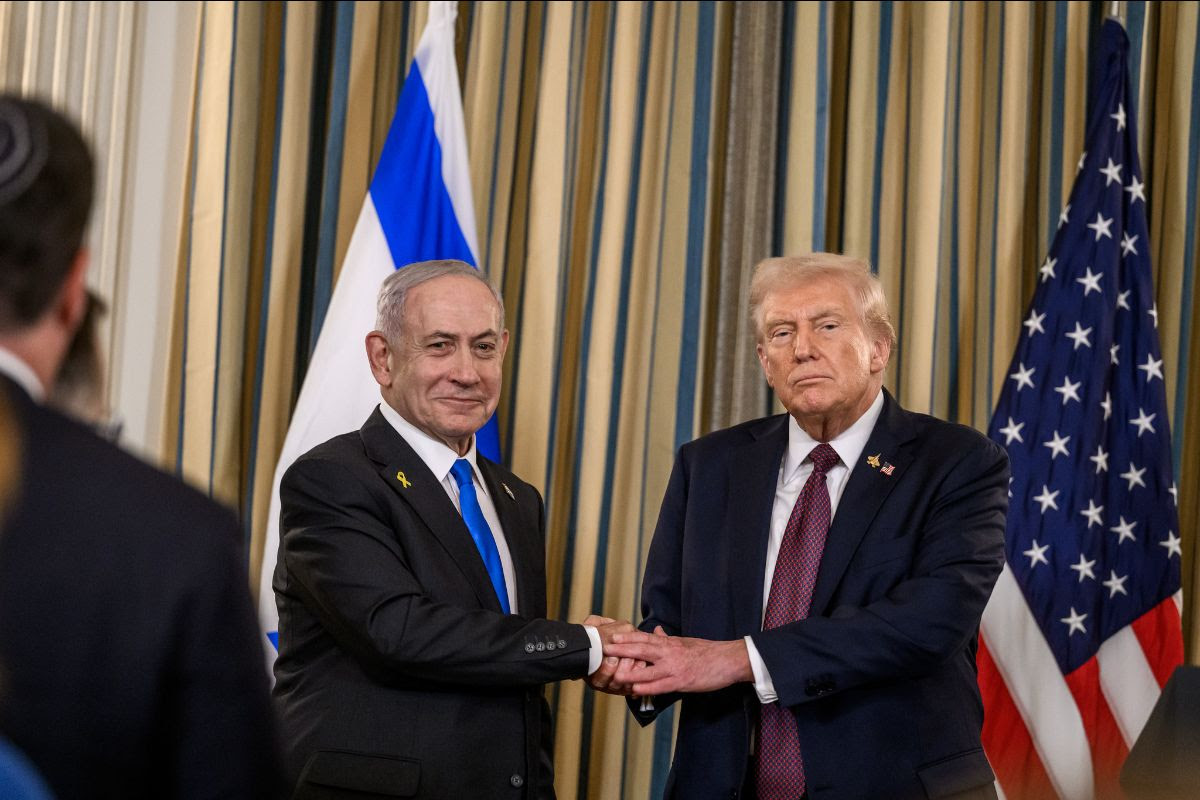
US President Donald Trump announced late Wednesday that Israel and Hamas have agreed to the first phase of his Gaza ceasefire deal. The Israeli government is set to meet Thursday to formally approve the deal, which would put the ceasefire into effect. The agreement, if fully implemented, would see the release of all Israeli hostages in exchange for Palestinian prisoners, entry of aid into Gaza, and the withdrawal of Israeli troops.
Watch for: Although all sides have agreed in principle to the ceasefire, several logistic gaps remain unresolved. The plan stipulates Israel will withdraw from Gaza to an “agreed-upon line”, but the specifics of that line is unclear. The timeline for the prisoner exchange is also yet to be finalized, though President Trump said in a Fox News interview that he expects it to take place “within the next few days, maybe Monday”. Any breach of the truce in its early stages could threaten the fragile momentum behind this agreement. For now, there is cautious optimism that the deal could mark a step toward ending the two-year war that has left more than 67,000 people dead in Gaza.
New French prime minister resigns
French Prime Minister Sébastien Lecornu resigned on Monday after just 26 days at the head of the French government, further deepening the crisis that has gripped the country’s politics over the past year. The decision was announced after Lecornu revealed his plans for cabinet appointments Sunday, prompting a wave of criticism by parties in France’s National Assembly. France’s latest political crisis started over a year ago when Macron called snap parliamentary elections in July 2024, resulting in a hung parliament. Since then, the National Assembly has been in a political standoff over the government’s proposed austerity budget plans, ousting Lecornu’s two predecessors, François Bayrou and Michel Barnier.
Watch for: President Macron is expected to name a new prime minister before the end of the week, in a fresh effort to resolve the ongoing political deadlock. Following two days of last-ditch talks with lawmakers, Lecornu said on Wednesday that the likelihood of snap elections was diminishing, and a tentative consensus on the 2026 budget was beginning to take shape. Still, whoever succeeds Lecornu will inherit an ideologically divided hung parliament and mounting pressure for elections to restore political stability.
Extended Outlook
What’s on our radar in the coming weeks…
Oct. 10-17
Oct. 10
- Nobel Peace Prize for 2025 will be announced
Oct. 12
- Portugal elections
- Cameroon presidential election
- Port of Dover and Folkestone Eurotunnel adopt EU digital border system
Oct. 13
- SpaceX plans 11th test flight of Starship
- 2025 Annual Meetings of the World Bank Group
Oct. 14
- Newfoundland and Labrador elections
- Brussels airport to cancel all outgoing flights due to strike
Oct. 15
- Russia-Arab summit
Oct. 16
- Turkey to hold 5G tender
- European Parliament and China’s National People’s Congress meeting
- Congo to replace cobalt export ban with quotas
Oct. 17
- Mexico teachers’ strike
Oct. 18-24
Oct. 19
- Bolivian presidential election runoff
Oct. 20
- 20th CPC Central Committee to hold fourth plenary session
- Australian prime minister visits White House
- Calgary elections
Oct. 21
- Fed conference on crypto and AI
Oct. 23
- Teachers, nurses, health care workers strike in New Zealand
Oct. 24
- Irish presidential election
- Rajya Sabha elections in Jammu and Kashmir
Oct. 25-31
Oct. 25
- Ivory Coast presidential election
Oct. 26
- Argentina midterm elections
- ASEAN summit
- India and China plan to restart flights
Oct. 27
- Trump visits Japan
Oct. 29
- Netherlands elections
- U.S. Federal Reserve’s decision on interest rates
Oct. 30
- APEC summit in South Korea
- India’s Noida International Airport to be inaugurated
Nov. 1-7
Nov. 1
- U.S. tariffs on medium- and heavy-duty trucks will go into effect
- Affordable Care Act enrollment period begins
Nov. 2
- Montreal mayoral election
- Yukon elections
Nov. 3
- FIFA U-17 World Cup in Qatar
Nov. 4
- U.S. election day
- Canada tables budget
Nov. 5
- U.S. Supreme Court hears case on Trump’s tariffs
Nov. 6
- FDA convenes meeting of external digital health advisors
Feature Photo: Chris Sampson, Wikimedia Commons

Factal gives companies the facts they need in real time to protect people, avoid disruptions and drive automation when the unexpected happens.
Try Factal for free or talk with our sales team (sales@factal.com) for a demo.